

Availability Heuristic Bias
finishing up my Bachelors of Science

An essay from last week

Making decisions can be difficult enough without the influence of cognitive biases developed from social influence or learned behaviors. Struggling to decide on my career, I focused heavily on what I had already learned about the industry and what others wanted and demanded. We were taught “the customer is always right.” Especially in the hospitality industry, where I assisted my mother for over 20 years. The cognitive bias that I chose for this week’s essay is “Availability Heuristic Bias.” This particular bias can impact one’s behavior, like most cognitive biases. The Bias I chose can be defined as “The overestimation of the information that one may have. Regardless. If it is accurate or not.” Operating under the availability heuristic bias can lead to making decisions based on fear, fight, or flight. Or the first thought or instinct one may have before evaluating essential factors. A real-life example of this is when I needed to decide whether to change my career focus. I could continue my mother’s hospitality business, or I could pursue my entrepreneurial goals further. One would think, why not continue an already successful business? Of course, it is stable, but when making decisions, you cannot just be pressured by your family or others. Even in this case, I would have instantly chosen to run her business. But the truth is, I knew that if I did that, I would also not be able to continue my pursuit towards social impact and change regarding those who have been through trauma and abuse.
The presence of availability heuristic bias suggests that pursuing an already established business would be beneficial. Still, the factors involved were not so significant; it would be the first choice that came to mind because it was easy and accessible, whereas my career is going to take time to cultivate and grow, and is more in alignment with my purpose and path. I grew up in a very competitive, toxic environment, and there would be too many complications and risks involved as the property was old and needed alot of money to make it fully operational. Now, if I had gone with my first instinct of needing to please already imposed expectations of taking over a family business, I would have missed out on writing, coaching, and helping women work through trauma. “What is my purpose? The question I resonated with the most in the example I explained above, and helped me dive deeper into taking my time to weigh out all the pros and cons of the situation without becoming emotionally attached or triggered. Then, after careful consideration of all factors, I was able to decline taking over the business and return to school to complete my bachelor’s degree. There will always be social influences, but I feel that the pressure from family is even worse because you feel a sense of loyalty or obligation to fulfill or satisfy them by agreeing or basing your decision on what is expected of you.
An example of how I used my current skills to positively impact my awareness of cognitive bias to create a strong and impactful career is that I have had to learn to distance myself from toxic people, such as my father, who is sixty and is currently serving a year’s sentence in jail for his 80+ offenses. I chose to write and help others through my memoir and other literary publications, and utilize my social media to inspire others to be more aware of their behaviors and those of others by respecting their boundaries and pursuing more spiritual and holistic practices, such as meditation and Reiki. Inspiring others to write and begin their story through my own advocacy helps them realize that, regardless of their experiences, pressures, or expectations, my goal is to allow purpose to guide my decisions through advocacy and soul-inspired work. As a trauma survivor, I understand the complexity of cognitive bias. As mentioned in the critical thinking guide, “All reasoning leads somewhere and has implications and consequences.” A powerful statement about using our critical thinking skills to overcome cognitive bias and make more informed, impactful decisions for positive influence and change in the future.
Resources and Citations:
Paul, R., & Elder, L. (2020). The miniature guide to critical thinking: Concepts and tools Download The miniature guide to critical thinking: Concepts and tools(8th ed.). Rowman & Littlefield.
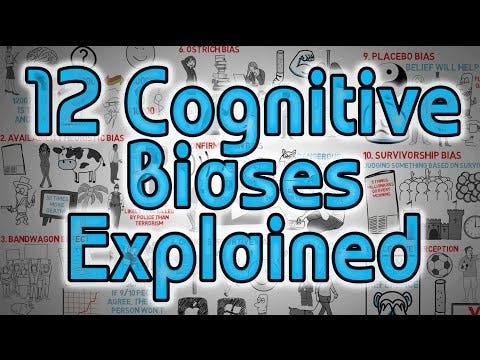
Practical Psychology. (2016, December 30). 12 cognitive biases explained—how to think better and more logically, removing bias. Links to an external site. [Video]. YouTube.
Rock it as always!!!!
You go!